Moneytree — Finance Made Easy
Connects bank accounts, credit cards, digital money, points, and cash spending in one place on Google Play in Japan.
 Season Two
 ApS · Copenhagen
Flæsketorvet 38B, 1711 København V, Denmark
Monday–Friday: 9:00 AM – 6:00 PM
Season Two ApS · Editorial desk, Copenhagen
Season Two ApS runs seasontwo-guide.com as an educational guide to personal finance apps for everyday money management in Japan. We explain expense trackers, budget planners, cash flow tools, and account aggregation in plain English. No trading signals, no approval promises — just practical reading that helps you compare options and ask better questions.

Chapter one
Many people download a personal finance app and stop after three days because logging feels slow. Think first about when you spend: convenience stores, trains, supermarket runs, subscriptions.
This page helps you match the habit before you compare names.
Chapter two
Kakeibo began as a traditional Japanese account book for personal finance management. Several current budgeting apps borrow its language of mindful spending, savings goals, and weekly reflection.
Kakeibo: Budget + AI describes itself as a budgeting app with an intelligent financial assistant that generates weekly and monthly budgets from savings goals. It also includes fast expense entry, sharing for family and friends, and weekly and monthly reports.
For readers in Japan, that mix of tradition and automation is a useful starting point — a paper habit with an app prompt attached.
Chapter three
We follow eight real products and concepts that appear in Japan listings and comparison discussions. Each one answers a different question about money.
Moneytree — Finance Made Easy
Connects bank accounts, credit cards, digital money, points, and cash spending in one place on Google Play in Japan.
Kanma — Personal Finance
Tracks investments including cryptocurrency, stocks, and exchanges, alongside subscriptions and transactions.
Summo
Listed in the Japan App Store in November 2026. Tracks spending, manages budgets, tracks credit card payments, includes iCloud syncing across devices.
PocketGuard
Focuses on visibility into available spending money, so you can see what is left before you spend it.
Kakeibo: Budget + AI
A budgeting app with an intelligent financial assistant that generates weekly and monthly budgets from savings goals.
YNAB — You Need A Budget
Built around zero-based budgeting and proactive planning: every unit of income is assigned a job.
The remaining names we follow — the generic Budget app - spending tracker and Kakeibo: Budget + AI's report screens — are covered further down the page and inside App Comparisons.
Chapter four · Rule of thumb
Strong apps keep the daily loop short. The second month is easier than the first — or the app will not survive.
The daily loop
Open · log · see balance · close
Keep the daily loop short
Four taps and you are done. If it takes longer, the app becomes a chore and the log stops.
Keep categories stable
Spending insights stay readable after a month only if the categories do not keep moving.
Show recurring expenses plainly
Subscriptions should be visible, not hidden inside a category that swallows them.
Keep the dashboard quiet
Average apps add charts but leave categorization messy, so the financial dashboard looks busy and tells you little.
Experienced users judge quality by whether the second month is easier than the first.
Review our evaluation approachChapter five
Ultra-fast expense entry is a listed feature of Kakeibo: Budget + AI. The generic Budget app - spending tracker, listed in the Japan App Store for spending tracking, budget planning, and money saving, also leans on simple value language around reducing expenses and increasing savings.
Speed comes from saved places, recent amounts, and default categories. Try logging a convenience store purchase while standing in line. If it takes more than a few taps, the app will not survive a busy week.
A week worth logging
Date · Amount
Reconcile against the card bill
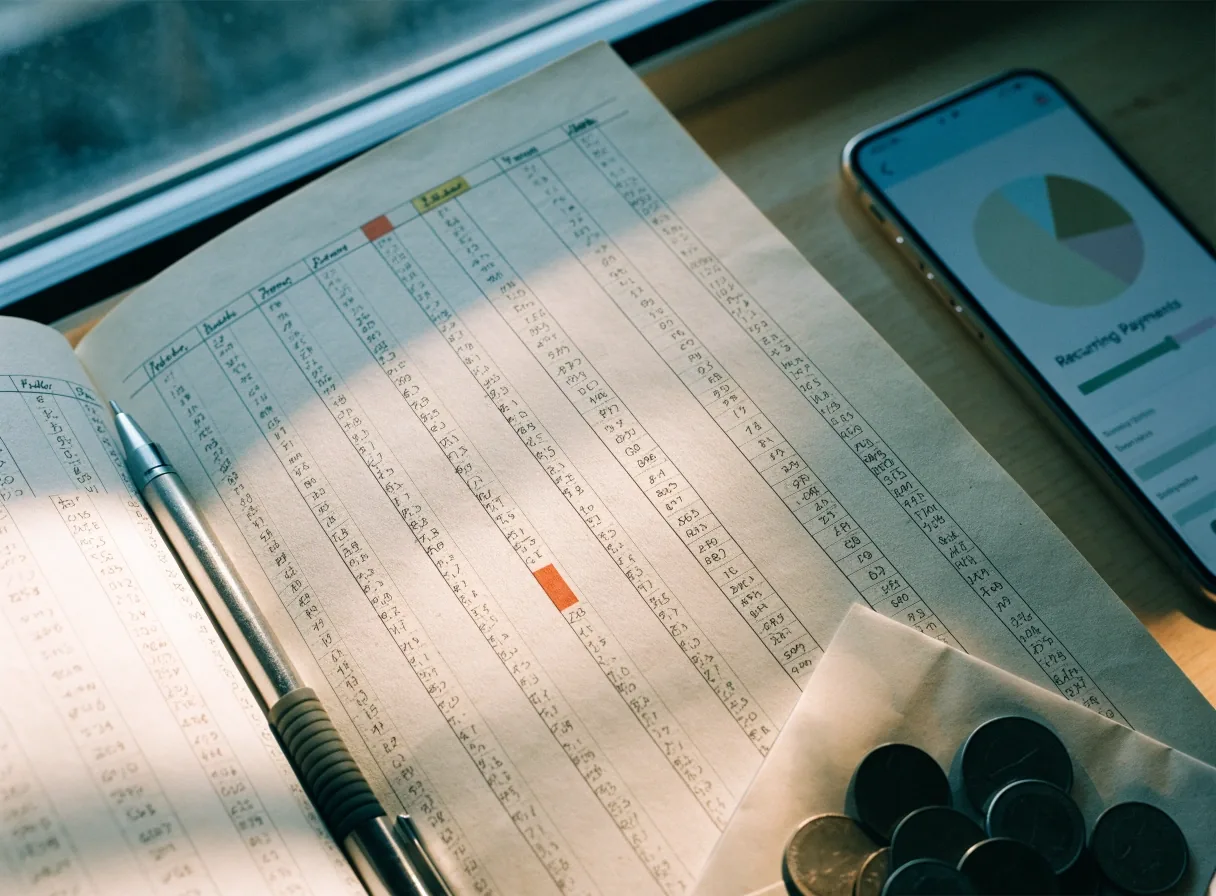
A practice-log folio in a Japanese household: date and amount in two ruled columns, the reconcile line drawn across the footer.
Chapter six
A cash flow planner answers whether bills and card payments fit before payday. Spending insights answer where money went after the fact.
Households with variable income in Tokyo, Osaka, or regional cities often need the first view. Students and single renters often learn more from the second.
Many expense tracker apps now offer both, but check which screen appears on open. The default screen shows what the product thinks matters.

Chapter seven
Aggregation — one dashboard
Pulls accounts together and shows assets against spending. Moneytree represents this side, with connections across banks, cards, digital money, and points. The mental model is one number, up to date.
Assignment — every unit spent
Divides money into purpose-based groups and asks you to stay within each. YNAB represents the zero-based budgeting side, where every unit of income is assigned a job before it is spent.
Choose the mental model you will actually maintain. Neither one wins on features alone — the one that survives week four is the one you keep.
Reading note
A frequent reader question is whether an English-language finance app can handle Japanese banks and credit cards. The answer depends on the specific connections each app maintains.
Products focused on Japan tend to document local coverage directly in their store listing. General global apps may offer manual entry and file import instead. If automatic connection matters to you, read the institution list carefully and test with one account before moving everything over.
Chapter eight
Small, repeated checks beat one long setup session. These are the three that end most attempts.
First mistake
Tracking everything in too much detail
Start with four to six categories. A taxonomy you cannot maintain stops getting filled in by the second week — and a half-empty ledger is worse than a small honest one.
Second mistake
Ignoring credit card timing
It makes cash flow look better than it is until the bill arrives. Summo and similar trackers that include credit card payments help here — the spend lands on the statement date, not the swipe date.
Third mistake
Forgetting subscriptions
Kanma lists subscription tracking with detailed statistics, which is a reminder to review monthly charges in one place. The small recurring ones are what quietly break a monthly plan.
Chapter nine
Readers often ask which finance apps work across iPhone and Apple Watch. Watch support varies by release and should be checked in the current listing.
Cross-device sync is clearer: Summo lists iCloud syncing across devices, which suits households that share budgeting on more than one iPhone or iPad. If you share with family or friends, also check how sharing handles privacy and who can edit. Shared clarity should not mean shared confusion.
Two devices, one budget, and a person who last edited it last Tuesday — the sharing question comes before the sync question.
Browse everyday money guidesFor readers who want one clear answer
Track connected accounts first
If you want daily expense tracking in Japan, start with transaction logging speed and Japanese institution coverage. Moneytree lists support for over 2,500 Japanese financial services and offers AI transaction categorization, custom notifications, spending periods, and a dashboard for assets, spending, and cash flow. That breadth reduces manual entry.
Reflect rather than connect
If your priority is reflection, a Kakeibo-style budget planner may suit you better: savings goals, weekly review, and fewer connected accounts to worry about. Our App Comparisons page walks through those trade-offs side by side.
Where to go next
Each article ends with a factual next step. Pick the one that answers the question you are actually carrying.
Methods
Kakeibo, envelope budgeting, and zero-based budgeting in plain terms.
Comparisons
Tracking style and planning method, side by side.
Everyday
Transaction logging tips, recurring expense checks, and dashboard habits.
Method
How Season Two ApS keeps comparisons useful.
Questions readers send
Short, factual answers. If a question needs a longer walk, the guide above it does that job.
Who publishes this resource
Season Two ApS is a Danish company based at Flæsketorvet 38B, 1711 København V, Denmark, CVR 44654881. The site seasontwo-guide.com is an editorial project about budgeting education and financial literacy, not a bank or an app vendor.
For topic suggestions or questions about editorial content, write to [email protected]. We reply during normal business hours in Copenhagen, Monday to Friday.
It depends on your payment mix. For connected accounts and local coverage, review institution support such as the range described by Moneytree. For manual reflection, review Kakeibo-style planners with fast entry and weekly reports.
Kakeibo is described in app listings as a traditional Japanese account book used for personal finance management. Apps use it to frame savings goals, mindful spending, and regular review.
Kanma lists investment tracking for cryptocurrency, stocks, and exchanges alongside subscriptions and transactions with detailed statistics. Check the current listing to confirm which connections are active.
Yes. Use the contact page to request information or discuss which guide to read next. We provide education, not personal financial advice.
Season Two ApS
The desk is cleared. The reconcile line is drawn.
Pick a page above, or write to us with a topic you want on the site. Editorially yours, Copenhagen.
Editorial office
Season Two ApSMonday–Friday: 9:00 AM – 6:00 PM
Contact Season Two ApS